Contrast curves & DPMs
Creation of a DetectionMap instance
In addition to the characterization of stars and substellar objects, MADYS provides another particularly useful feature for the high-contrast imaging (HCI) community: namely, the capability to convert detection limit curves of a HCI observation into mass limit curves and completeness maps.
The computation is mediated by the DetectionMap class. Let us analyze the syntax needed to initialize an instance:
file = "examples/SPHERE_contrast_curve.fits"

params = {'parallax': 5.8219, 'parallax_error':0.31,
          'ebv': 0.04, 'ebv_error': 0.01,
          'app_mag': 6.182, 'app_mag_error': 0.233,
          'band': 'SPH_K1', 'age': 16.,
          'age_error': 7.
         }

curve = DetectionMap(file, 'contrast_map', params)
The basic inputs needed to create an instance are therefore:
file: path-like, numpy array or tuple, required. Input contrast curve. It can be:if
file_type= ‘contrast_separation’:a 2D numpy array, with size (n_points, 2), where the first column stores contrasts, the second one separations in arcsec;
a tuple (contrasts, separations), with the two items being numpy arrays as in 1);
a valid .fits file containing the data, formatted as in the array case. In this case, two keywords
OBJECTandPIXTOARCare expected in the header, corresponding to the name of the star and the platescale in mas/px.
if
file_type= ‘contrast_map’:a 2D numpy array, with size (n_x, n_y), representing the contrasts achieved for any pixel in the original image;
a valid .fits file containing the data, formatted as in the array case.
file_type: string, required. It can be either:‘contrast_separation’, if a 1D curve(separation) with shape (n_points, 2) is provided;
‘contrast_map’, if a 2D curve(x, y) is provided. A 3D map (lambda, x, y) is accepted too.
stellar_parameters: dict, required. A dictionary containing information for the star under consideration. The following keywords must be present:‘parallax’: float. Stellar parallax [mas];
‘parallax_error’: float. Uncertainty on stellar parallax [mas];
‘app_mag’: float. Apparent magnitude of the star in the ‘band’ band [mag];
‘app_mag_error’: float. Uncertainty on ‘app_mag’ [mag];
‘band’: string or list. Filter(s) which the map refers to. It (They) should be valid filter name(s) for MADYS. If the input map is a 3D map (band, x, y), a list can be used to attribute the individual slices along the first axis to different bands. In this case, the program will convert each slice individually and then take (pixel-wise) the best mass limits.
‘age’: float. Stellar age [Myr];
one between:
‘age_error’: float. Uncertainty on stellar age [Myr]. It must be larger than 0.
a couple ‘age_min’, ‘age_max’: float. Lower and upper values for stellar age [Myr]. ‘age’, ‘age_min’, ‘age_max’ must strictly satisfy the relation: age_min < age < age_max.
For extinction, two possibility exist:
either it is set explicitly through the following doublet of keywords:
‘ebv’: float. E(B-V) reddening for the star [mag];
‘ebv_error’: float. Uncertainty on E(B-V) [mag];
or coordinates must be specified to allow the program to estimate E(B-V):
‘ra’: float. Right ascension of the star [deg];
‘dec’: float. Declination of the star [deg].
‘ext_map’: string, optional. 3D extinction map used for the computation. Possible values: ‘leike’, ‘stilism’. Default: ‘leike’. In this case, the error on ebv is always set to 0.
In addition to this, a dictionary is required to be supplied through the keyword sequence_parameters if file is not a path to provide missing information. Its keywords are:
‘OBJECT’: string. Name of the star;
‘PIXTOARC’: float. Platescale [mas/px] (only mandatory if file_type = ‘contrast_separation’).
Finally, an optional dictionary can be provided through the keyword exodmc_parameters. This specifies the parameters of the grid for all the completeness maps created from this instance.
Once created, the instance possesses the following attributes:
file: path-like, numpy array or tuple. Corresponding to input ‘file’.file_type: string. Corresponding to input ‘file_type’.stellar_parameters: dict. Corresponding to input ‘stellar_parameters’.data_unit: string. Corresponding to input ‘data_unit’.rescale_flux: float. Corresponding to input ‘rescale_flux’.minimum contrast: float. Corresponding to input ‘minimum_contrast’.contrasts: numpy array. Renormalized contrast curve (flux ratio).contrasts_mag: numpy array. Renormalized contrast curve (magnitude contrast).header: fits.Header(). Header of the input file (empty header if file is not a filepath).abs_phot: numpy array. Absolute magnitudes in the required filters.abs_phot_err: numpy array. Uncertainties on absolute magnitudes in the required filters.abs_phot: numpy array. Apparent magnitudes in the required filters.abs_phot_err: numpy array. Uncertainties on apparent magnitudes in the required filters.mag_limits: numpy array. Limit absolute magnitudes corresponding to input curve.mag_limits_err: numpy array. Uncertainties on limit absolute magnitudes.mag_limits_app: numpy array. Limit apparent magnitudes corresponding to input curve.mag_limits_app_err: numpy array. Uncertainties on limit apparent magnitudes.separations: numpy array. Input separations, iffile_type=’contrast_separation’; zero-filled array otherwise.band: string. Input stellar_parameters[‘band’].platescale: float. Platescale of the instrument FOV [mas/px].object: string. Object name.exodmc_object: ExoDMC instance. It defines the grid of parameters across which DPM are evaluated.mass_limits: dict. It stores the mass_limits produced byDetectionMap.compute_mass_limits()to avoid repeating the computation if the model does not change.
Creation of mass curves
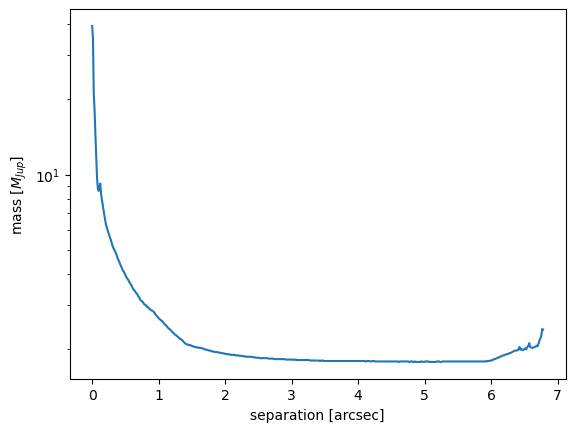
Starting from the object create above, it’s easy to compute the corresponding mass curve through the function DetectionMap.compute_mass_limits():
mass_limits_dict = curve.compute_physical_limits('atmo2020-ceq')
If file_type =’contrast_map’, the program will additionally collapse the map along the azimuthal direction, yielding a (N-1)-dimensional output in addition to the N-dimensional mass curve.
The output of DetectionMap.compute_mass_limits() is a dictionary, which stores as many dictionaries as the number of filters in curve.band. Each of these subdictionaries contains several outputs depending on the input type. The 1D arrays for separations and mass maps are stored under the keywords separation, mass_map_1D, mass_map_1D_min, mass_map_1D_max, where the last two indicate the lower and upper mass limits. If curve.file_type == ‘contrast_map’, the additional 2D curves are stored under the keywords mass_map_2D, mass_map_2D_min, mass_map_2D_max. In the example above:
mass_array = mass_limits_dict['SPH_K1']['mass_map_1D']
separation_array = mass_limits_dict['SPH_K1']['separation']

plt.plot(separation_array, mass_array)
plt.yscale('log')
plt.xlabel('separation [arcsec]')
plt.ylabel(r'mass [$M_{Jup}$]')
plt.show()
Detection probability maps: basics
A completeness map, or detection probability map, is a way to account for the observational biases underlying a direct imaging observation. Given a planet mass and a semi-major axis, it quantifies the probability that such a planet be detectable in the observation. This is particularly important in the context of surveys, where the true occurrence rate of planets must take into account the uneven coverage of the parameter space.
MADYS employs ExoDMC (Bonavita 2020) to create a grid of orbital parameters. For each planet mass and semi-major axis, 1000 orbits are randomly generated; after estimating the resulting projected separation, the planet’s flux (estimated from its mass and age) is compared to the contrast limit at that separation.
As mentioned above, the parameters of ExoDMC can be set using the keyword exodmc_parameters when the instance is initialized. The dictionary can have the following keywords:
x_min: float. Lower limit for grid x axis (default = 1);x_max: float. Upper limit for grid x axis (default = 1000)nx: int. Number of steps in the grid x axis (default = 100)xlog: bool. If True the x axis will be uniformly spaced in logy_min: float. Lower limit for grid y axis (default = 0.5)y_max: float. Upper limit for grid y axis (default = 75)ny: int. Number of steps in the grid y axis (default = 100)ylog: bool. If True the y axis will be uniformly spaced in logngen: float. Number of orbital elements sets to be generated for each point in the grid (default=1000).e_params: dict. Specifies the parameters needed to define the eccentricity distribution. If used, the following keys can/must be present:‘shape’: string, required. Desired eccentricity distribution. Can be uniform (‘uniform’) or Gaussian (‘gauss’)
‘mean’: float, optional. Only used if shape = ‘gauss’. Mean of the gaussian eccentricity distribution.
‘sigma’: float, optional. Only used if shape = ‘gauss’. Standard deviation of the gaussian eccentricity distribution.
‘min’: float, optional. Only used if shape = ‘uniform’. Lower eccentricity value to be considered.
‘max’: float, optional. Only used if shape = ‘uniform’. Upper eccentricity value to be considered.
Default: ‘shape’ = ‘gauss’, ‘mean’ = 0, ‘sigma’ = 0.3.
i_params: dict. Specifies the parameters needed to define the inclination distribution. If used, the following keys can/must be present:‘shape’: string, required. Desired inclination distribution. Can be uniform in cos(i) (‘cos_i’) or Gaussian (‘gauss’)
‘mean’: float, optional. Only used if shape = ‘gauss’. Mean of the gaussian inclination distribution [rad].
‘sigma’: float, optional. Only used if shape = ‘gauss’. Standard deviation of the gaussian inclination distribution [rad].
Default: ‘shape’ = ‘cos_i’.
Note
xlog and ylog are False by default in ExoDMC. However, we strongly advise the user to set xlog and ylog to True to avoid losing sensitivity at the low-mass and the low-sma edges, where the most interesting information is found.
Let us create now a detection probability map:
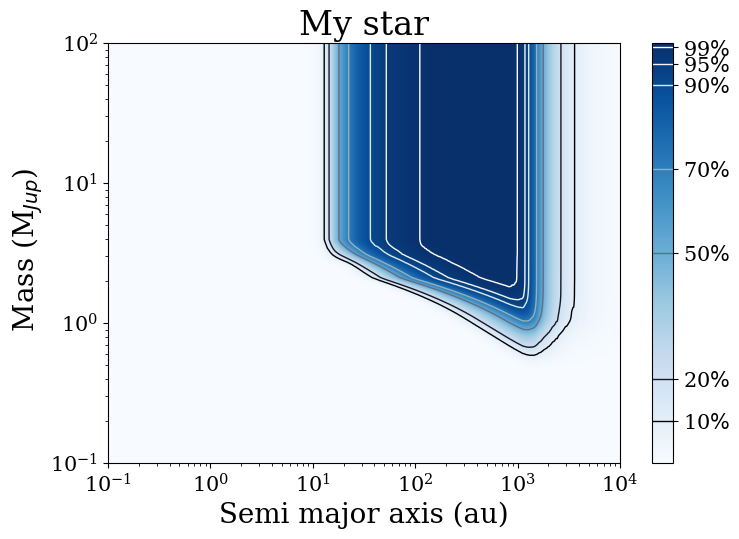
dpm = curve.compute_completeness_map('atmo2023-ceq', plot=True)
or equivalently:
dpm = curve.DImode_from_contrasts('atmo2023-ceq', plot=True)
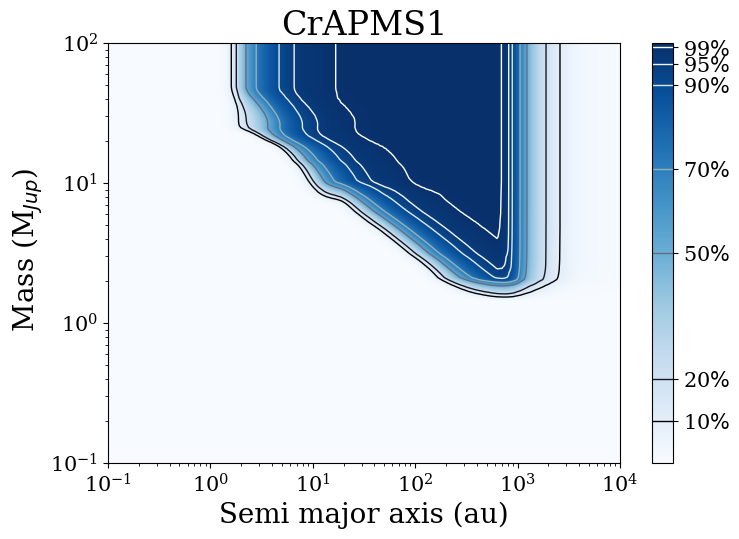
The output of DetectionMap.compute_completeness_map() is a dictionary, which stores as many dictionaries as the number of filters in curve.band. Each of these subdictionaries contains the keyword mass_dpm, sma_array, mass_array, model, extrapolate (see Detection probability maps: advanced).
Temperature curves & DPM
In alternative to the detection probability in the (sma, mass) plane, one might be interested in computing the detection probability of a planet in the (sma, Teff) plane. This map can be obtained by means of the keyword include_teff:
dpm = curve.compute_completeness_map('atmo2023-ceq', plot=True, include_teff=True)
The subdictionaries inside dpm will, in this case, contain the additional keywords Teff_dpm and Teff_array. The values defining the Teff array can be changed by using the keywords Teff_min, Teff_max, Teff_min, nTeff, logTeff in the Exo-DMC dictionary. By default, a uniform array (in linear space) between 200 K and 3000 K is defined.
Note
For the sake of code optimization, temperature DPMs are computed from mass DPMs via a change of variables. Therefore, a too narrow mass grid might imply an incomplete coverage of the Teff space – which might lead to a nan-filled or with a largely extrapolated Teff map. For this reason, we suggest keeping the default value of y_max (100 M_J) when computing Teff DPMs. In this case, the plotting of mass DPMs can be easily adjusted using the function plot_completeness_map().
Detection limits in the temperature space can be determined in the same way as mass limits:
teff_limits_dict = curve.compute_physical_limits('atmo2020-ceq', quantity='Teff')
In analogy with their mass curves, these curves are stored under the keywords Teff_map_1D, Teff_map_1D_min, Teff_map_1D_max (and Teff_map_2D, Teff_map_2D_min, Teff_map_2D_max if the input map is 2D). It is possible to compute mass and Teff limits in one shot, by setting ``quantity``=[‘mass’, ‘Teff’].
Detection probability maps: advanced
Sometimes, the dynamical range of a model are not sufficient to cover the entire age/mass range that is desirable. An example is provided in the image below:
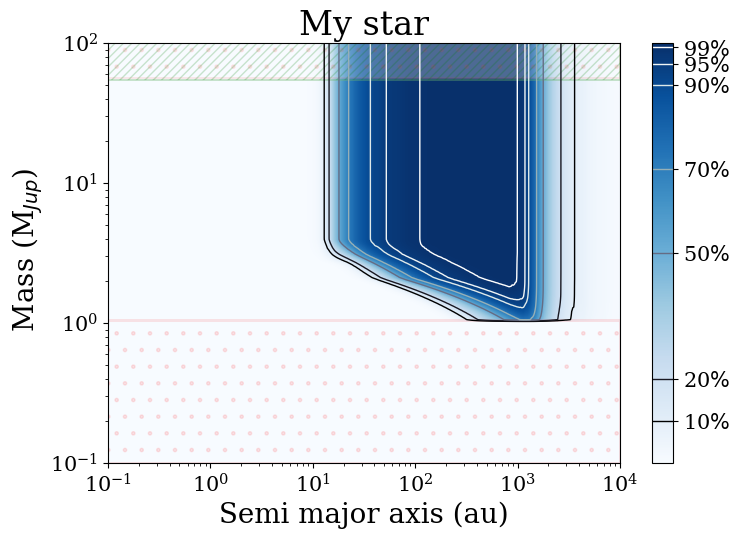
where the dotted area indicates the region where the model matrix is nan-filled. This can be seen explicitly by calling the helper function DetectionMap.visualize_grid_coverage():
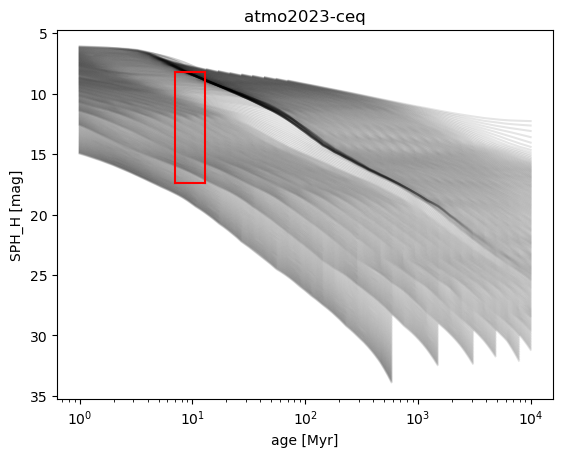
In such cases, the user might consider activating the extrapolation option (see here for usage and caveats).
dpm = curve.compute_completeness_map('atmo2023-ceq', plot=True, extrapolate=True)
Saving curves & DPMs
The contrast curves can be exported to .fits files using the keyword to_file in compute_physical_limits(). A full path to the output file can be specified; alternatively, the boolean value True will create a file for each of the 1D/2D mass/Teff limits named self.object+'_mass/Teff_limits_1D/2D_'+model_version+'.fits. These files contain a header specifying how to read the data, and detailing the stellar parameters used to handle the conversion.
As regards DPMs, a dedicated function DetectionMap.save_dpm() exists. For example, given the instance curve defined above,
curve.save_dpm(dpm, 'atmo2023-ceq', output_file, dtype='mass')
Here, a string output_file must be explicitly specified. The keyword dtype can be either ‘mass’ or ‘Teff’.